
Kroger Dismantles Its Ocado Network: Billion-Dollar Vision Turns Into Industry Warning
A partnership once hailed as grocery’s automated future is now being dismantled — with a $350M penalty, three massive CFC closures, multiple spoke shutdowns, and deep implications for the future of online fulfillment.
Kroger and Ocado’s $350M Divorce: The Largest Automation Collapse in Modern Grocery
Kroger’s decision to cancel the upcoming Charlotte CFC — and pay Ocado $350 million in penalties — isn’t a strategic reset. It’s the collapse of one of the most ambitious, expensive, and visible automation projects ever attempted in North American retail. What began as a billion-dollar blueprint to reinvent grocery fulfillment is now being dismantled piece by piece, leaving behind shuttered facilities, stranded capital, and a long list of lessons retailers cannot ignore.
This is not a slowdown.
This is a divorce — and the fallout is enormous.
A Billion-Dollar Model That Couldn’t Survive Real-World Economics
When Kroger and Ocado unveiled their U.S. partnership in 2018, the industry saw it as a turning point: a fully automated, highly centralized grocery delivery network powered by a cutting-edge robotic cube system. It promised efficiency, precision, and national reach.
But as the network rolled out, the economics began to fail:
CFCs required massive up-front investment.
Profitability relied on extreme volume density — which most U.S. markets cannot support.
Centralized automation increased delivery distances.
Customer expectations shifted toward same-day, even same-hour fulfillment.
The model struggled when order volatility increased.
By 2024, the cracks were impossible to ignore.
The Core Problem: Ocado’s Cube System Was Never Designed for Modern E-Commerce Speed
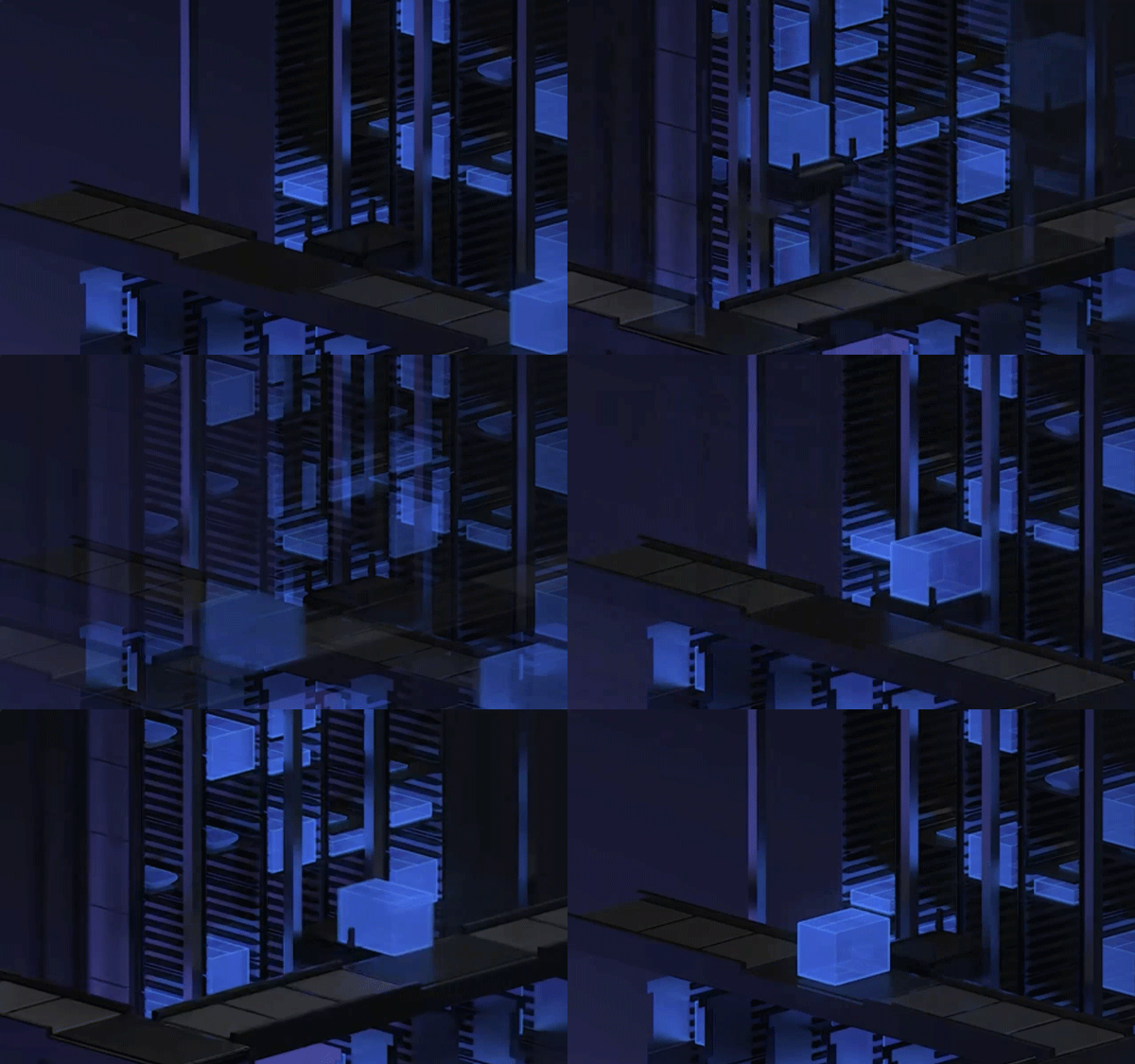
One underreported factor in this collapse is the original purpose of Ocado’s cube-like AS/RS architecture.
The concept was born in the late 1990s to maximize storage density in constrained warehouse space — not to handle high-velocity, real-time e-commerce orders. The first commercial deployment in 2005 used only five robots and around 6,000 bins, a system built for maximum capacity efficiency rather than fulfillment speed.
The cube design is clever and highly space-efficient, but it carries structural limitations. Its “natural slotting” behavior can become a critical bottleneck where picking, sorting, and merging certain types of online grocery orders becomes painfully slow, unproductive, and costly to fulfill.
These issues were reported by Kroger to Ocado soon after the first CFCs went live. Ocado’s engineering teams worked hard to optimize software and workflows, but they were never able to fully overcome the inherent design constraint of the cube storage architecture.
In a grocery world where customers expect rapid fulfillment, constant reprioritization, and same-day delivery, this constraint becomes a massive operational choke point.
Modern e-commerce rewards:
Fast retrieval
High SKU turnover
Order variability throughout the day
Minimal internal travel
Ocado’s cube system optimizes for the opposite: maximum density over maximum speed.
This mismatch sits at the heart of why the Kroger–Ocado model failed to scale sustainably.
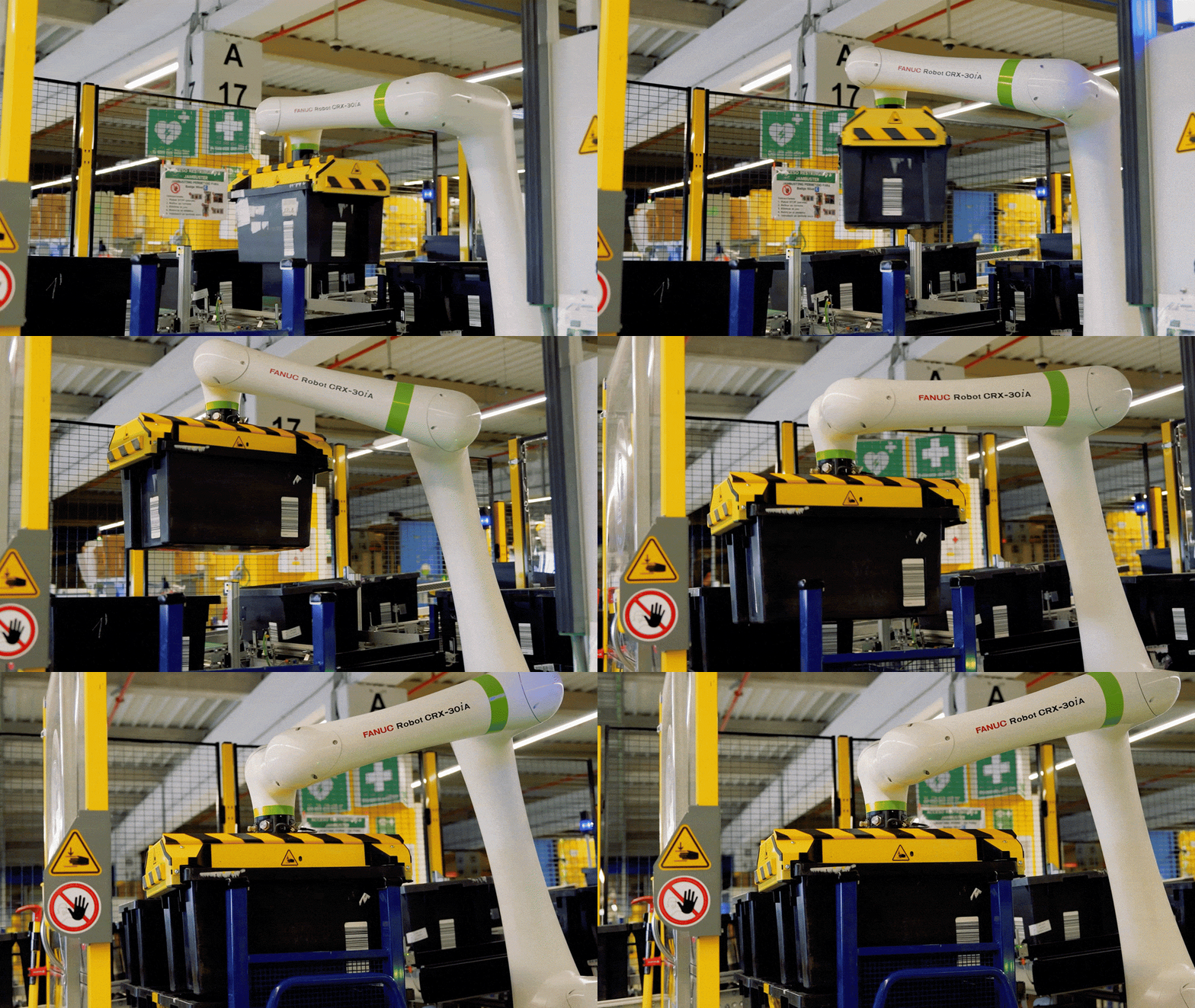
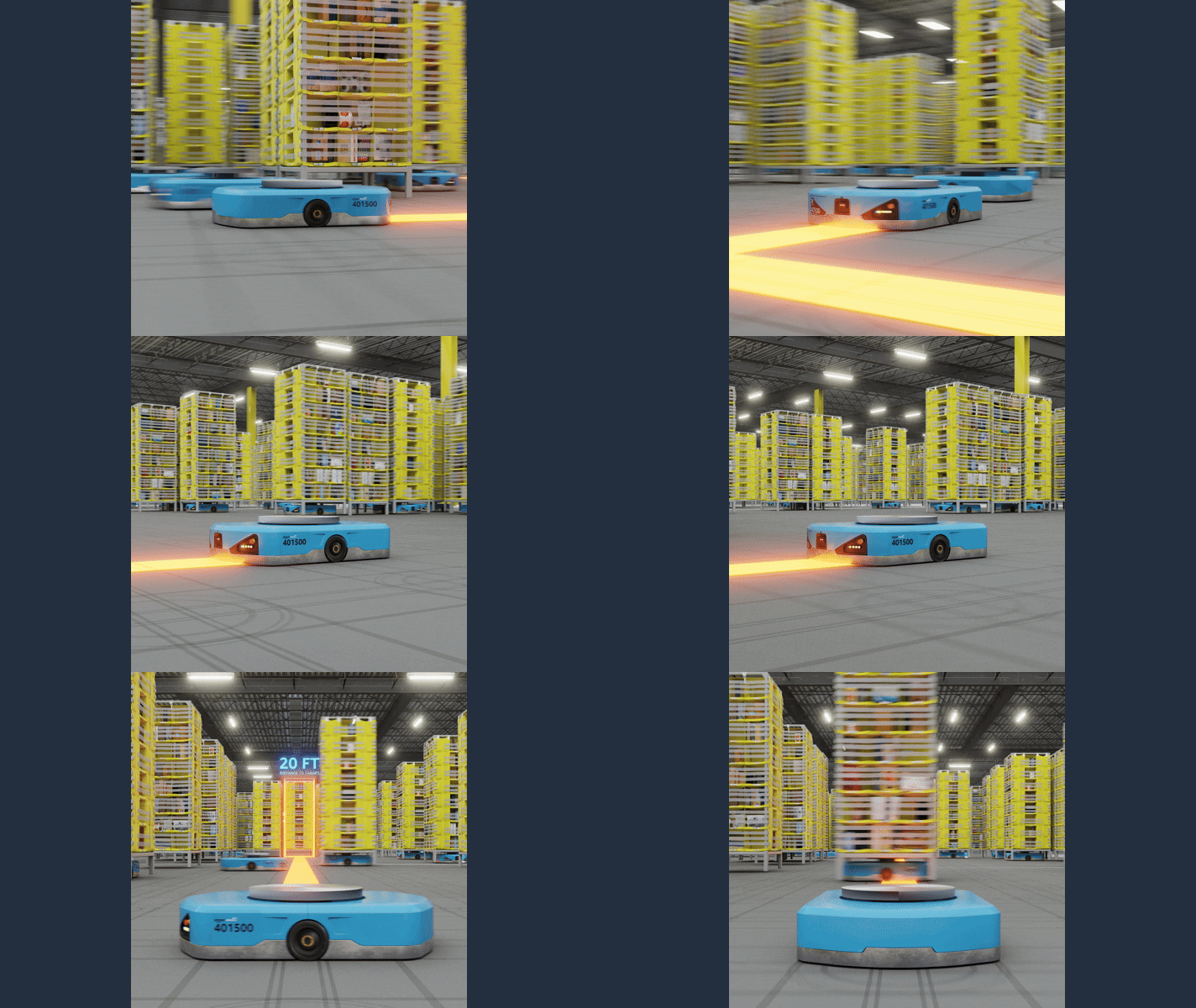
For comparison, Amazon is still using the robotic system it acquired from Kiva in 2012 — now known as Hercules. With continuous software and hardware improvements, Amazon has been able to steadily refine the Hercules system to support faster and faster delivery promises to its online customers.
The Fallout Is Enormous
Kroger’s unwinding of the Ocado partnership is not just a financial hit — it is the largest automation retreat the U.S. grocery sector has ever seen.
The $350M penalty payment is only one part.
Kroger has also confirmed the closure of:
Three massive CFCs (Wisconsin, Maryland, Florida)
Multiple spoke facilities, including Nashville in early 2026
Additional Florida and Virginia spokes under the Harris Teeter banner
These facilities were once marketed as the backbone of Kroger’s automated future. Today they are shuttered assets, empty buildings, and significant layoffs.
The consequences include:
Hundreds of job losses across multiple states
Billions in capital tied to a model being abandoned
A direct financial blow to Ocado
Local economies losing promised robotics-driven employment
Industry-wide reevaluation of automated grocery fulfillment strategies
It is one of the most significant reversals in modern retail automation history.
And it forces the industry to confront a difficult question:
If the most well-funded, best-publicized automated grocery network failed to achieve sustainable economics, what does that say about the model itself?
A Shift Toward Store-Based Fulfillment and Speed-Driven Networks
Kroger now publicly acknowledges that online grocery profitability depends on:
Proximity-based fulfillment
Store-assembled orders
Flexible delivery windows
Partnerships with Instacart, DoorDash, and Uber
Lower capital intensity
Faster cycle times
In short: the company is abandoning centralized robotics in favor of distributed fulfillment closer to the customer — the model Amazon, Walmart, and Target already follow.
No automation system can overcome the physics of distance.
The Industry Lesson
This breakup reveals more than a misaligned partnership. It exposes the underlying truth about grocery automation:
Automation cannot overcome weak network design.
Storage efficiency is not a substitute for retrieval speed.
E-commerce grocery is too volatile for slow, centralized systems.
The future belongs to flexible, edge-based, store-integrated fulfillment networks.
No Perfect Automated System — Which Is Exactly Why Independent Guidance Matters
One of the deeper lessons here is that no automation system is flawless. Cube AS/RS, shuttles, pouch systems, AMRs, micro-fulfillment, even next-generation humanoids — all come with strengths and non-negotiable tradeoffs.
The risk arises when retailers commit to a system without fully understanding:
Its operational bottlenecks
Its cost structure under real demand patterns
Its performance during peak periods
Its impact on delivery speed and customer satisfaction
Its long-term flexibility — or lack of it
This is why retailers increasingly engage third-party advisors, such as Warehouse Automation, before committing to multimillion-dollar automation strategies that will define their competitiveness for the next decade.
The right automation system can accelerate growth.
The wrong one can trap a company in slow fulfillment, high operating costs, and shrinking market share.
In today’s retail landscape, selecting the right system isn’t an innovation decision — it’s a survival decision.
Why Ocado Is Reframing Its Strategy — And Highlighting Store-Based Automation
Ocado Automation Didn’t Fit the U.S. Market — Announces Store-Based Solution

Ocado's new fulfilment solutions ecosystem
One day after Kroger announced the closure of three Ocado-powered Customer Fulfillment Centers (CFCs) and a US$2.6 billion impairment charge, Ocado released a detailed press statement presenting a “flexible ecosystem” of fulfillment options, including a new store-based automation module.
The timing is clear: Ocado is moving quickly to reposition the narrative.
But the substance of their message — and what remains unsaid — is even more revealing.
Ocado’s American ambitions have suffered a serious setback after Kroger, its main U.S. supermarket partner, retreated from the robotic-warehouse deal that underpinned the British group’s push into the world’s largest grocery market.
Kroger’s decision has triggered one of the most significant conversations in years about the future of online grocery automation in North America. And Ocado’s response unintentionally validates many of the underlying issues retailers — and the industry — have been debating for years.
1. Ocado Is Now Leading With “Flexibility” Because the Original Model Lacked It
Ocado’s new message emphasizes:
“There is no one-size-fits-all… retailers need a mix of solutions.”
This marks a significant shift from the company’s historic positioning.
For nearly two decades, Ocado’s CFC model was built on a very specific set of assumptions tied to the early UK online grocery environment:
Ocado’s original model was designed for weekly pre-scheduled delivery slots.
In the 2000s and early 2010s, UK households often:
booked the same weekly delivery window
submitted large, predictable baskets
ordered on a weekly rhythm
created long, stable cutoff windows
produced high route density
made batching and wave-based picking extremely efficient
This is the predictable demand profile Ocado’s centralized CFC architecture was engineered to optimize.
But that world no longer exists — not in the UK, and certainly not in the U.S.
Today:
UK consumers increasingly expect next-day or same-day delivery
click-and-collect has grown
baskets are smaller and more frequent
order patterns are more volatile
Ocado’s system still reflects the architectural DNA of its early design assumptions — and this mismatch lies at the center of the Kroger situation.
2. Ocado’s “New” Store-Based Automation Isn’t New — It Echoes Years of Failed MFC Experiments Across the Industry
Ocado’s press release frames store-based automation as a natural extension of CFC automation:
“A compact, automated warehouse within or next to an existing store.”
The description is clean and well-positioned.
But the U.S. market tells a very different story.
From 2018 to 2022, nearly every major U.S. retailer aggressively tested store-based micro-fulfillment automation — and most deployments failed.
Systems from:
Takeoff Technologies
Dematic (shuttle MFCs)
Fabric
Attabotics
Alphabot
were shut down or quietly removed because they were:
operationally messy
difficult to maintain
extremely expensive per order
prone to downtime
disruptive to store operations
hard to staff
dependent on high volumes to justify the capex
unable to adapt to the volatility of U.S. grocery demand
These systems didn’t stall because retailers lacked interest in automation — they stalled because the ROI never materialized under real operating conditions.
This is the context missing from Ocado’s release.
3. Why Retailers Have Shifted Back to Manual In-Store Fulfillment
Today, nearly all large U.S. retailers — including Walmart, Target, Albertsons, H-E-B, Meijer, and Kroger itself — are doubling down on manual in-store picking supported by strong orchestration software, because it is:
fast to deploy
low risk
low capex
highly flexible
easy to scale during peak seasons
consistent with consumer expectations (same-day and sub-two-hour)
aligned with dense store networks
This shift has nothing to do with rejecting automation.
It’s a response to the fact that:
The U.S. market rewards flexibility, not mechanical complexity.
Most ASRS-based micro-fulfillment attempts failed not because of the technology itself, but because the economics and operating conditions simply did not support them.
4. Ocado’s Announcement Protects the CFC Narrative — But Avoids the Central Issue
Ocado’s statement stresses:
“Store-based automation is not a replacement for large CFCs, but a complementary solution.”
This is understandable — CFCs are core to Ocado’s identity and long-term contracts.
But Kroger’s decision highlights several realities Ocado’s messaging does not address:
the CFC model underperformed in multiple U.S. markets
cost-to-serve increased even as online volume scaled
CFC economics depend on UK-style density, which the U.S. lacks
real-world operating costs grew instead of shrinking
Kroger paused further CFC rollouts before these closures
digital demand growth never corrected the economics
The silence on these issues is telling.
5. Connecting the Dots: The Real Reason Kroger’s Ocado Model Struggled
The heart of the issue is simple:
Kroger’s online business grew — but its fulfillment costs grew even faster.
This is the opposite of what the Ocado model promised.
Ocado’s architecture assumed:
stability
batching
large baskets
fixed delivery windows
high route density
strong weekly patterns
The U.S. market delivers:
volatile order timing
smaller baskets
same-day and sub-two-hour expectations
heavy click-and-collect adoption
low density across large geographies
unpredictable waves of demand
The result?
The Ocado CFC model was fundamentally mismatched to U.S. grocery behavior.
This was not a failure of robotics.
It was a failure of design assumptions.
Ocado’s press release indirectly acknowledges this reality by repositioning the company as flexible and modular — traits not inherent in the original CFC model.
The Bottom Line
Ocado’s response is polished and well-timed.
But it also reinforces a broader truth:
**There is no universal automation model for grocery fulfillment.
Only the right model for the right market.**
Kroger’s pivot — and Ocado’s reframing — highlight how fast the online grocery environment is changing:
customer expectations are accelerating
delivery windows are shrinking
demand volatility is increasing
margins remain thin
retailers require flexibility, not rigid infrastructure
capital-heavy automation is under increasing scrutiny
The future of grocery fulfillment will be defined not by any single technology, but by how well retailers align automation with the realities of their markets.
Warehouse Automation’s Slant
The Kroger–Ocado story is not about failed technology.
It’s about a misalignment between system design, customer behavior, and market economics.
Our team works with retailers and brands to:
assess automation fit
evaluate fulfillment models
analyze cost-to-serve
avoid vendor lock-in
build flexible, scalable architectures
select technology that matches their real operating environment
If your organization is reassessing its online fulfillment strategy or evaluating automation options, we’d be happy to support the discussion.
Why Kroger Is Closing Three of Its Ocado Automated Fulfillment Centers?
Kroger announced that it will close three of its Ocado-powered Customer Fulfillment Centers (CFCs) — Pleasant Prairie (WI), Frederick (MD), and Groveland (FL) — as it restructures its e-commerce operations for long-term profitability. The closures come with a $2.6 billion impairment charge in fiscal Q3 and form the core of Kroger’s plan to improve digital profitability by approximately $400 million in 2026.
Despite five consecutive quarters of double-digit e-commerce growth, Kroger stated that its digital business remains unprofitable — a structural issue the retailer has been trying to address since early 2022.
Kroger’s Network Review: Strong Growth, Weak Profitability
Earlier this year, Kroger initiated a “full site-by-site analysis” of its automated network, jointly built with U.K.-based automation provider Ocado. After this review, Kroger determined that three of the CFCs did not meet the performance or demand-density thresholds required to justify their high fixed costs.
The affected facilities represent one of the shortest operational lifespans of any major North American automated grocery projects:
Groveland, Florida — Opened June 2021
Pleasant Prairie, Wisconsin — Opened June 2022
Frederick, Maryland — Opened June 2023
Some of these sites operated for barely 18 months before closure.
Kroger noted that it will continue monitoring the performance of its remaining CFCs and will keep using automated fulfillment in high-density markets where the economics justify it. But the overall message is clear: the centralized CFC model must prove its value.
A Strategic Pivot: From Centralized Automation to Flexible Fulfillment
Alongside the closures, Kroger outlined a significant evolution in its e-commerce strategy:
1. Increased reliance on in-store fulfillment
Kroger plans to expand store-based picking — and will begin piloting capital-light, in-store automation to increase capacity without major capital expenditures.
2. Deeper integration with third-party fulfillment partners
Kroger is strengthening its relationships with:
Instacart — now its primary delivery fulfillment provider
DoorDash — offering delivery from nearly 2,700 stores
Uber — partnership expanding in early 2026
Kroger will also be one of the first retailers to test Instacart’s conversational AI ordering tools within the Kroger mobile app.
3. Selective use of Ocado CFCs
Two previously announced CFCs — in Charlotte and Phoenix — are still planned for fiscal 2026, though neither Kroger nor Ocado offered an updated timeline.
Market Reaction: A Major Blow to Ocado’s U.S. Strategy
Ocado’s stock dropped as much as 18%, hitting its lowest level since 2013. Analysts described Kroger’s move as a severe setback:
“This is pretty devastating for Ocado Group because the USA is the flagship international market for its tech.”
The two companies have been in partnership since 2018, with the original goal of scaling to 20 CFCs across the U.S. That roadmap is now uncertain.
Ocado will receive over $250 million in compensation for the early closures, but it expects a $50 million reduction in fee revenue this year.
A Deeper Angle: Ocado’s Technology Is Brilliant — But Built for a Different Era
The Kroger news is important on its own, but it also exposes a deeper structural issue that has been evident for years:
Ocado’s automation platform is superb from a technical standpoint — but it was originally architected for a very different operating model than what U.S. retailers require today.
Let’s break down why this matters.
1. Ocado Was Designed for Scheduled, Predictable UK Home Delivery
Ocado’s system remains one of the most advanced in the world — high-density grids, swarming robots, complex routing algorithms, and powerful orchestration software.
However, the Ocado Smart Platform was engineered more than a decade ago for the U.K. online grocery model, which is characterized by:
Pre-booked delivery slots
Next-day and scheduled delivery
Predictable daily waves
High basket sizes
Repeat weekly order patterns
Dense, urban delivery routes
This model relies on predictability. Ocado’s architecture thrives on batching, consolidation, and consistency — the core operating patterns of UK online grocery.
This is well documented in early Ocado investor briefings, interviews with Ocado executives, and technology case studies during the Smart Platform’s rollout.
2. The U.S. Market Is Fundamentally Different
Kroger faces a completely different e-commerce environment. Over the past decade, U.S. consumers have shifted toward:
Same-day and increasingly sub-2-hour delivery expectations
Massive adoption of click-and-collect/curbside pickup
Smaller, more frequent baskets
Unpredictable, continuous order flow throughout the day
Lower delivery density across vast suburban geographies
This level of volatility and geographic spread is almost the opposite of Ocado’s design assumptions.
3. CFC Economics Break Down When Volume and Density Don’t Match
Ocado’s large CFCs work best when:
Order volume is extremely high
Delivery routes are compact
Orders can be batched and waves optimized
Customer behavior is predictable
Some Kroger markets simply do not reach the demand density required to amortize the fixed costs of an Ocado CFC. When the model is underfed, the economics break — even if the technology itself performs flawlessly.
This is not a technology problem.
It’s a market-fit problem.
4. U.S. Grocers Are Moving Toward Flexibility, Not Centralization
Across the industry, U.S. retailers are shifting their e-commerce strategies toward:
In-store fulfillment
Back-of-store micro-fulfillment
Capital-light automation pilots
Third-party delivery platforms
Hybrid fulfillment models
Rapid implementation over long-term construction projects
Kroger’s new direction — combining selective CFC use with extensive store-based fulfillment and deep third-party partnerships — is fully aligned with this trend.
Bottom Line
Ocado’s automation technology remains highly sophisticated. That isn’t what’s driving Kroger’s restructuring.
The core issue is structural misalignment between Ocado’s original design assumptions and the fast-paced, unpredictable, same-day fulfillment patterns that define U.S. online grocery.
Kroger isn’t retreating from automation.
Kroger is retreating from a model that was built for another market — one that assumes predictability and density rather than the flexibility and real-time volatility required in American grocery e-commerce.
Warehouse Automation’s Take
As the Kroger–Ocado story shows, the technology itself is rarely the problem. The real challenge is matching the right automation model to the realities of the operation, the market, and the customer experience you’re trying to deliver.
Our team specializes in helping retailers, brands, and logistics operators evaluate these trade-offs — from centralized fulfillment and micro-fulfillment to goods-to-person systems, robotics, and advanced orchestration software.
If your organization is rethinking its automation strategy, exploring alternatives, or assessing the fit of existing systems, we’d be glad to help you chart the right path.








Amazon just announced the expansion of one-hour and three-hour delivery across the U.S.