
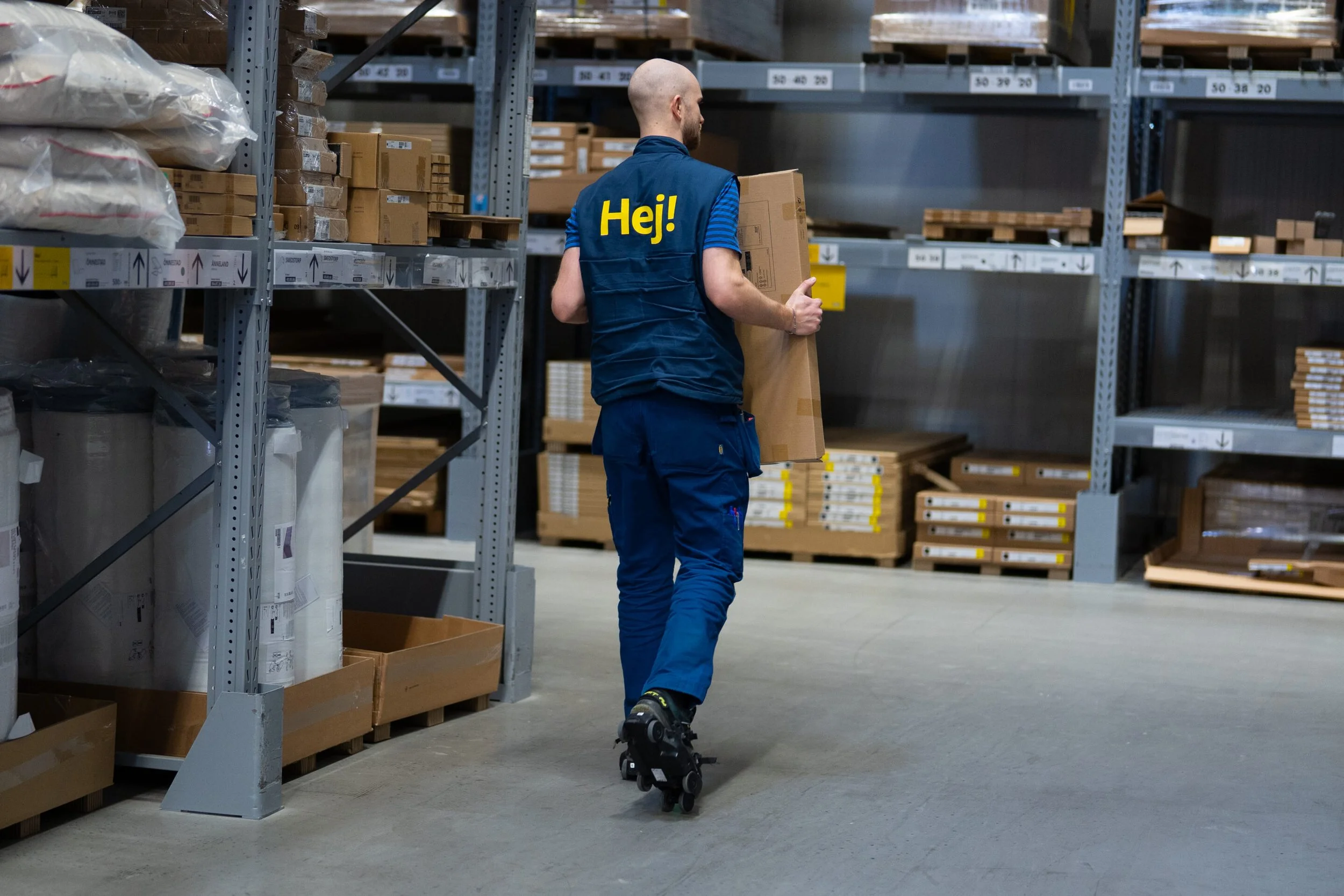
Ikea is testing robotic boots in Helsingborg, Sweden, to speed up order picking and reduce physical strain. Initial measurements showed that employees walked up to twice as fast, and average hourly picking productivity increased by 16%.


One of over 40 tests
The so-called Moonwalkers, which are worn over regular shoes, use AI to adapt to the wearer’s walking rhythm. The trial began after an employee saw an advertisement for the robotic shoes and ordered a pair to test them. The system is designed for employees who pick orders in various fulfillment zones and aims to both increase speed and reduce physical strain.
Moonwalkers are part of more than 40 automated solutions, including AI and robotic technologies, that support employees at Ikea stores worldwide. “Our colleagues have responded very positively—and so have our customers,” said Sebastian Carlius, fulfillment operations manager at Ikea Helsingborg, in a press statement. “People see something new, something that works, and that sparks curiosity. That energy is what drives us to keep looking for better ways to do things.”
According to Ikea, the project demonstrates that operational initiatives can emerge from employees who are on the shop floor every day. “What the team in Helsingborg has done is a great example of that—taking the initiative, testing something new, and sharing what they’ve learned,” says David McCabe, global fulfillment and core services manager at Ingka Group.
From Ikea Newsroom:
When the Artemis II crew pushed further into space than any humans before them, they reminded the world that curiosity and a willingness to try something new can take you further than you ever imagined. At IKEA Helsingborg, Sweden, a small team had a similar thought – just a little closer to the ground.
It started simply. A co-worker spotted an advert for a pair of robotic boots called Moonwalkers. They ordered a pair. They tried them on. And then they walked – up to two times faster than normal. The early results at IKEA Helsingborg have been encouraging, with overall picking productivity per hour rising by 16 percent.
Moonwalkers are robotic boots that fit over regular footwear and use adaptive AI technology to match each person’s natural walking style. For co-workers picking orders across large fulfilment areas, that speed makes a real difference: more ground covered, more orders fulfilled, and a smarter way to work.
“Our co-workers have responded really positively — and so have our customers,” says Sebastian Carlius, Fulfilment Operations Manager at IKEA Helsingborg. “There’s a genuine sense of excitement. People see something new, something that works, and it sparks curiosity. That energy is what drives us to keep looking for better ways of doing things.”
What makes this story particularly IKEA is how it started: not from a top-down directive, but from a team that saw a possibility and decided to explore it. That spirit – curious, hands-on, and a willingness to take responsibility and try – is when IKEA works at its best.
As Neil Armstrong said, standing on the moon on 20 July 1969: “That’s one small step for a man, one giant leap for mankind.” At IKEA Helsingborg, they’d probably just call it a good idea worth trying.
Good ideas come in all shapes and sizes
Moonwalkers are used at IKEA Helsingborg as part of a broader commitment to investing in tools that make work smarter – not harder. It sits alongside more than 40 automated solutions, including AI and robotics, already supporting co-workers across IKEA units worldwide.

David McCabe, Global Fulfilment & Core Services Manager, Ingka Group
“At IKEA, we believe the best ideas often come from the people closest to the work. What the team in Helsingborg has done is a great example of that — taking initiative, testing something new, and sharing what they’ve learned. That’s how we improve, together.”





At Hannover Messe 2026, SAP and Vodafone showcased a pilot conducted at Vodafone’s warehouse in Duisburg,