
Why UPS Just Bought Hundreds of Truck-Unloading Robots
UPS Buys Hundreds of Robots to Unload Trucks in Automation Push
UPS recently committed $120 million to roughly 400 robotic systems designed to unload trailers and shipping containers. This was not an experimental pilot or a public-facing innovation announcement. It was a scaled purchase following years of validation.
More importantly, it targets one of the least automated — and most operationally painful — workflows in logistics: inbound unloading at the dock.
Inbound Unloading: Still Largely Manual
While sortation, storage, and picking have seen steady automation over the past two decades, truck unloading remains overwhelmingly manual across the industry.
The reasons are well known:
Loads are unstructured
Cartons vary widely in size, weight, and stability
Containers shift as they are emptied
Most facilities were never designed for robotic access
Inbound also sits at the very start of the operational chain. Any slowdown at the dock immediately cascades downstream into storage availability, picking waves, and outbound cutoffs. In practice, this makes unloading one of the most consequential — and least forgiving — workflows in a facility.
Why Pickle Met the Bar
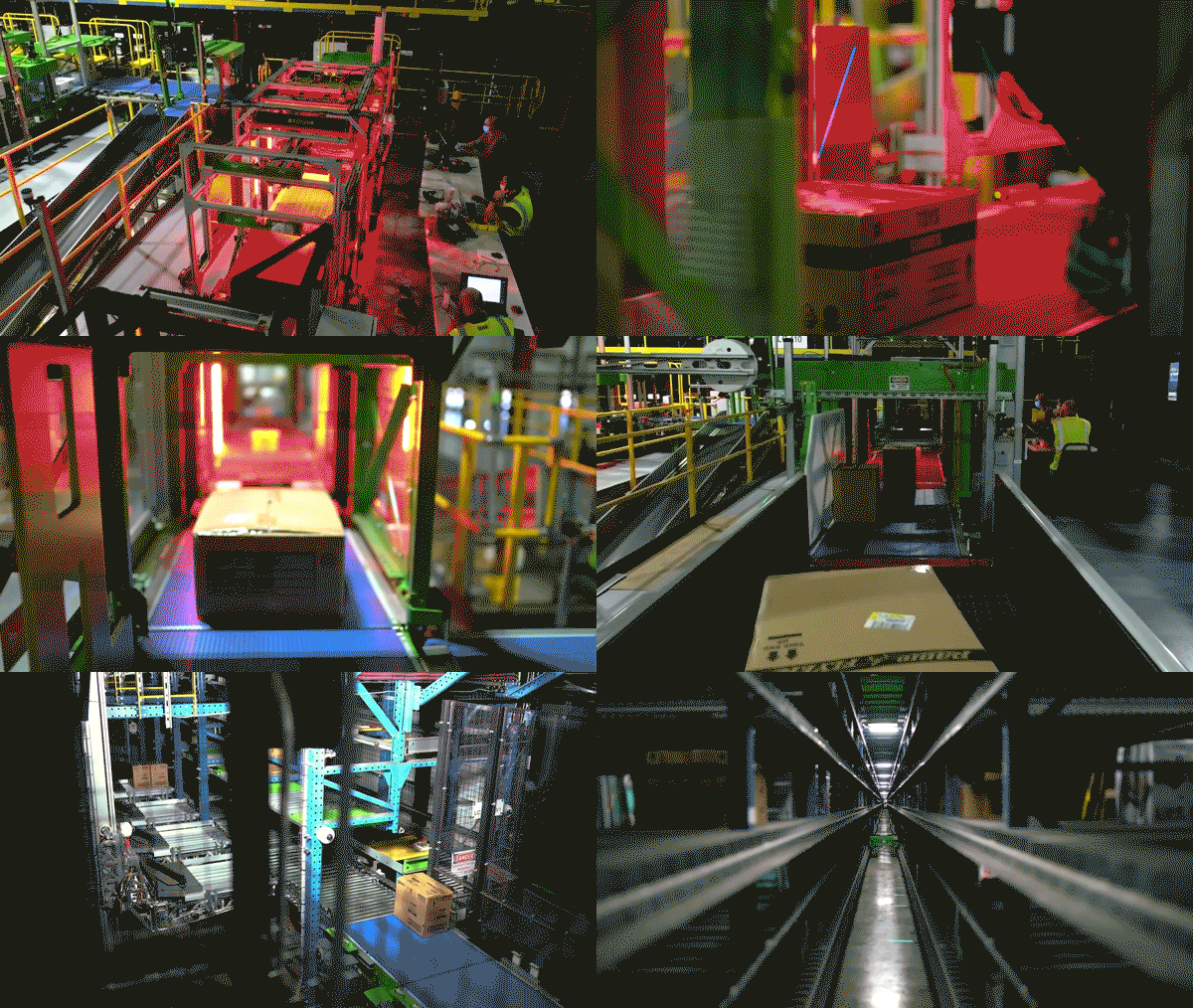
Pickle Robot’s system focuses narrowly on this problem. It is a robotic arm mounted on a mobile base that drives directly into standard trailers and containers, lifts cartons using suction, and places them onto conveyors.
From UPS’s perspective, several characteristics stand out:
Deployable in existing warehouses
Handles cartons up to ~50 lb
Unloads a typical trailer in roughly two hours
Demonstrated payback of approximately 18 months
That final point explains the scale of the order. Large operators do not deploy hundreds of units unless the economics are already proven and repeatable.
Automation as Cost Control, Not Experimentation
This purchase aligns with UPS’s broader restructuring strategy.
In 2024, the company announced a $9 billion automation investment across more than 60 U.S. facilities, with a stated goal of $3 billion in cost savings by 2028. In parallel, UPS has closed facilities, reduced headcount, and deliberately trimmed low-margin e-commerce volume.
Within that context, inbound unloading automation serves a very specific role:
Reducing reliance on hard-to-staff dock labor
Improving throughput consistency
Lowering injury exposure and physical strain
Stabilizing operations during peak demand
UPS describes this in terms of safety and ergonomics, which is accurate. But the underlying driver is structural cost reduction.
How This Compares to Amazon, DHL, and FedEx
What makes UPS’s move particularly interesting is how different it is from other large logistics players.
Amazon has invested heavily in automation across fulfillment, but inbound unloading has remained largely manual. Amazon’s scale allows it to absorb labor volatility, and its focus has been on downstream speed, buffering, and sortation rather than dock-side robotics.
DHL has taken a more incremental approach. It has experimented with robotic unloading and mobile manipulators, but deployments tend to remain localized, often tied to specific regions, customers, or innovation centers rather than broad network-wide rollouts.
FedEx has focused more on sortation automation and network optimization than on automating inbound container unloading at scale. Where robotics are used, they are often tightly coupled to specific hub designs rather than broadly deployable brownfield solutions.
UPS’s decision stands out because it represents a scaled commitment to inbound automation inside existing facilities, rather than a selective or experimental deployment.
Executive Summary
UPS’s purchase of hundreds of truck-unloading robots is not about robotics novelty or AI signaling. It reflects a practical conclusion: manual inbound unloading no longer scales economically.
The technology reached a point where it could be deployed into real warehouses, deliver a predictable payback, and directly support a broader cost and margin strategy. By automating the very first physical workflow in logistics, UPS is addressing variability at its source — rather than compensating for it downstream.
Inbound is no longer treated as untouchable. That shift, more than the robot itself, is the real signal.


At Hannover Messe 2026, SAP and Vodafone showcased a pilot conducted at Vodafone’s warehouse in Duisburg,